
For many years, I have recommended that South Africans make use of their annual R1 million offshore allowance – whether in full or in part – as a priority investment. For anyone looking to build global wealth or hedge against long-term currency decline, this remains an extremely powerful tool.
But you won’t often hear this advice from your local asset manager. They typically steer clients toward a Tax-Free Savings Account (a valuable product, but limited in scale), or (less appropriately for young investors) a retirement annuity (RA).
RAs are suitable only for investors committed to staying in South Africa long-term. Your money is locked away until age 55, you may only access one-third at retirement, and withdrawing funds if you emigrate can be exceptionally difficult.
In his article on BizNews, What my R23,000 dinner in London Taught Me (https://www.biznews.com/thought-leaders/what-r23-000-dinner-london-taught-me-magnus-heystek) Mr Heystek compares several investment avenues:
- Using your R1m offshore allowance for global equities
- A Tax-Free Savings Account (invested in global equities)
- Retirement annuities (restricted by Regulation 28)
- Discretionary investments in global equities in South Africa
Mr Heystek has nailed his colours to the mast, voting strongly in favour of investing offshore via your annual R1m investment allowance.
I don’t believe it’s as simple as a one size fits all answer.
Overall, it depends on many factors including your appetite for risk, whether you are a disciplined investor, your attitude to financial issues and your behavioural financial biases etc.
Often the best solution for an individual is the one that they can commit to without succumbing to fear, greed etc and not the theoretically best from a financial or mathematical perspective. The right solution depends on numerous factors:
• Your risk appetite
• Your level of financial discipline
• Your attitudes and behavioural biases
• Your long-term intentions
Often, the best investment is not the one that performs best on paper, but the one an individual can stick to without being derailed by fear or greed.
All else being equal, despite its limited annual and lifetime contribution caps, a Tax-Free Savings Account (TFSA) is the first investment I recommend for most clients.
I have outlined the following scenario comparing the investment options listed above:
- A 25-year-old invests R36,000 on 1 March each year. In the 14th year he only invests R32,000 as the R500,000 lifetime maximum for a TFSA is reached.
- The TFSA, the offshore allowance and local discretionary investment all invest in global equities with a long-term assumed annual return of 15% a year in Rand
- RA investment is subject to Regulation 28 and hence can invest a maximum of 75% in equities, and a maximum of 45% in global equities. The assumed long-term return is 10% a year. To ensure we are comparing apples with apples, the amount invested in the RA is higher due to the tax relief. For someone paying marginal tax of 45% the equivalent investment amount is R65,455 and if marginal tax is 31% then the annual investment amount is R52,174.
*Inflation is assumed at 5% a year
The following table shows the market value (MV) and present value (PV) of these funds in 40 years’ time when our 25-year-old reaches age 65, as well as the assumed PV after tax.
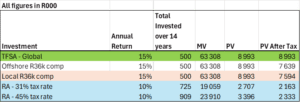
Determining capital gains tax payable in 40 years’ time on offshore and local discretionary investments requires some assumptions.
My base assumption assumes that SARS continues to adjust the various tax rates, thresholds and annual exclusions to allow for the “bracket creep” effect of inflation. This has not happened for the last 2 years but is a reasonable assumption and simplifies the calculations.
Based on this an effective capital gains tax rate is approximately 15%. (The highest this rate can currently be is 40% “inclusion rate” x 45% “maximum marginal tax rate” = 18%).
The assumptions required for the Retirement Annuity are broader. In addition to above inflationary tax adjustments, I have assumed:
- 1/3 of benefit is taken and taxed as a lump sum
- Tax rate that applies in retirement on income will be one tax band lower, ie for a 45% marginal tax rate payer above the tax rate applied to the income is 41%.
*I have weighted these tax rates.
Overall, I have tried to make assumptions that are broadly neutral and do not favour one investment option over another. Some people may believe my 15% long-term annualised return for global equities is too aggressive. I don’t believe that is the case as consistent high performing funds with long histories such as the S&P500, Orbis Global Equity and Ranmore Global Equity funds have earned >10%, >12% over 35 years and >12% over 17 years to 30 September 2025 in $ respectively.
The historic Rand depreciation has accounted for the additional return. For comparison purposes I have reproduced the table above assuming a 14% return for global equities:
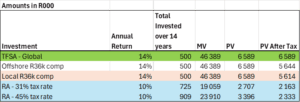
While it reduces the value of TFSA and discretionary funds invested in global equities, the overall picture remains the same.
- The TFSA provides after tax asset values almost 20% higher than the discretionary investments invested offshore using the R1m annual allowance or invested locally.
- The offshore investment is slightly higher given the slightly lower capital gains tax. The difference between this investment is less than 1%.
- The RA provides the lowest after-tax result after 40 years, despite having invested more money. This is due to the remarkable power of compound interest and the higher returns which can be earned by investing 100% in equities and in particular global equities.
- The TFSA provides an after-tax PV approximately 3x that of RA assuming a long-term return of 14% and if the long-term return earned is 15% then this increases to a PV approximately 4x that of RA.
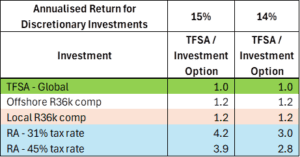
So clearly, the mathematics show that a TFSA invested in rand-denominated global equities delivers superior after-tax results compared to investing directly offshore in the same underlying fund denominated in $, € or £.
So why should you still consider using your R1m annual allowance, or a portion of it, to externalise assets?
There are several important reasons:
- Regulatory diversification and political risk protection.
For me, the most compelling reason is the possibility of another “Nhlanhla Nene moment” – when the then finance minister was abruptly removed by President Jacob Zuma in 2015. Many South Africans suddenly found themselves asking: What the f$*$%&. What if I need to leave? How quickly can I move my money? More politely this may be phrased as regulatory diversification. In a nutshell it is looking ahead and protecting as many assets as sensible against a worst-case political scenario in South Africa.
2. Access to a much broader global investment universe.
While you can access global equities in rand from South Africa, investing offshore offers two key advantages:
- Choice.
You gain access to a much larger range of unit trusts, ETFs, and equities across all global stock exchanges. For some investors this is empowering, for others, overwhelming.
- Favourable tax treatment of currency movements.
In rand-denominated global funds, any capital gains or losses arising from exchange-rate fluctuations form part of your taxable gain when you sell. In contrast, in foreign-currency-denominated offshore funds, exchange-rate movements are excluded from the capital gains calculation.
In South Africa, you can gain exposure to foreign currencies and global businesses through several vehicles – whether via a TFSA, a discretionary investment, or a retirement product. Each serves a particular purpose and meets different investor needs.
I generally advise clients to prioritise:
- Maximising their TFSA, given its exceptional long-term tax advantages and the ability to invest fully in global equities.
- Using retirement vehicles, which come with significant restrictions (Regulation 28), and limitations regarding when and how much of your funds you can access before age 55. While many see this as a negative or constraint, I believe this protects many individuals from unnecessarily withdrawing funds due to panic during market crashes.
- Then making use of the R1m discretionary offshore allowance, where appropriate and affordable. (And of course, if you have the means, you can pursue both strategies concurrently.)
As with all financial decisions, there are important nuances and exceptions. For a deeper comparison – including the trade-offs between a TFSA and a Retirement Annuity – refer to my article: “Tax-Free Savings Accounts (TFSAs): The best investment vehicle many people have never heard of” here
Ultimately, the right structure is the one that gives you growth, protection, optionality, and the highest likelihood of staying invested through the ups and downs over the long term. A high equity TFSA, combined with RA’s or employer structured retirement vehicles and thoughtful offshore diversification, remains one of the most powerful ways for South Africans to build resilient global wealth