I continue to be amazed when speaking to young adults or Millennials how few of them have heard of TFSA’s and that even fewer are using them to save for their retirement.
The benefits of TFSA’s are primarily, you guessed it, that they are free from tax for as long as you live. That could well be as long as 100 years and if so a total investment of R500,000 over 14 years, could provide all the savings you need for your retirement.
Despite being introduced in March 2015, nearly 10 years ago, most people have far less understanding of TFSA’s and the benefits they offer and how to maximise these.
The 2025 tax year comes to an end on 28th February and there are many articles highlighting the potential ways of minimising one’s taxation. I read 2 articles recently which I found rather misleading and disappointing.
The first detailed the various retirement savings products, their benefits, and the legislation that governs them. It provided a thorough and accurate accounting of retirement vehicles, except that it completely omitted TFSA’s – in my opinion the best retirement funding vehicle for Millennials or those with at least 20 years to invest – from the article.
Below is a summary of the key characteristics of retirement funds and TFSAs as they pertain to this comparison.
Retirement Fund – Retirement Annuity (RA), Pension or Provident Fund
- Contributions are made with pre-tax money (subject to certain limitations)
- Subject to regulation 28 (max 45% overseas, max 75% equities) and hence long-term returns are expected to be lower than 100% equity investment
- 2-Pot system allows access to 1/3 of funds annually
- Retirement lump sum is subject to retirement lump sum tax and regular pension / annuity withdrawn is subject to normal income tax
TFSA
- TFSA can be invested in almost any assets without any restriction
- TFSA can be accessed at any time without restriction
- Proceeds from TFSA and all growth are tax free
TFSAs are not constrained by Regulation 28, and you can therefore invest 100% in equities and in particular global equities thereby earning a significantly higher return. The longer the investment period the greater this advantage becomes. Given the long investment horizon, volatility is not really an issue.
The main caveat is that unlike retirement annuities and pension and provident funds the 2-Pot handrails do not exist and there is nothing stopping you from withdrawing from the TFSA before retirement, thereby losing the massive long-term tax-free growth benefits available.
This is best illustrated by way of an example.
Lethabo and Mia are starting work both aged 25.
Lethabo has a marginal tax rate of 45% and Mia’s marginal tax rate is 18%. They are planning on saving towards retirement, 45 years away and given the long investment horizon and their attitude to risk are comfortable investing in high growth assets like equities both SA and global equities.
They are looking for advice as to how best to save for their retirement. The standard financial advice is to invest first in a retirement vehicle and only once this has been done to consider investing in a TFSA. My advice given their characteristics would be quite different.
To make the financial comparison we need to make some assumptions and ensure we do a like for like comparison.
They can invest in an S&P500 ETF earning a long-term return of 15%. The actual annualised net total return in ZAR earned over the last 10 years is 18.8% as per S&P Global. Local S&P500 Feeder ETF’s have a low tracking error over long durations. The S&P500’s long term (>50 years) average $ return is 10.1% pa and in the long-term ZAR depreciates by 5% pa against $.
It is much more difficult to come up with a reasonable Balanced or regulation 28 compliant average return, but I would expect this to be 4-5% lower than the return assumed above.
The ASISA Multi Asset High Equity (regulation 28 compliant) unit trust category shows a best return earned over the 10 years ending 31 December 2024 of 11.7%, while the average return is a paltry 7.4%.
This average return difference is a key assumption. I have assumed a difference of 4% or a balanced return of 11% for comparison purposes.
Lethabo and Mia can both afford to invest the maximum R3,000 monthly into a TFSA.
Alternatively, Lethabo can invest an equivalent R5,455 pm into an RA and Mia R3,659 pm, after allowing for the tax savings the RA offers.
On the face of it, it seems as if the standard advice is sensible, however over time the higher returns available via TFSA outweigh the lower investment amounts.
For the purposes of this comparison all contributions cease after 167 months when the R500,000 TFSA lifetime contribution maximum is reached and remain invested until retirement. Lethabo and Mia will continue to make use of retirement fund vehicles as necessary to meet their retirement needs.
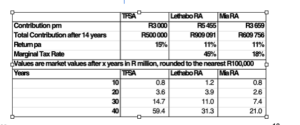
After 10 years the impact of the higher return has overtaken the higher contributions made by Mia but not for Lethabo, given his higher marginal tax rate. After 22 years Lethabo ‘s TFSA exceeds his retirement fund.
Thereafter the TFSA continues to outperform the retirement fund, and this differential becomes greater and greater over time.
At retirement their TFSA’s are each worth R59.4m. This is nearly double Lethabo’s RA and nearly triple Mia’s RA!
As advertisements love to say, that’s not all. The above comparison ignores the significant additional benefit which a TFSA has over a retirement fund – that all withdrawals from the TFSA are tax free.
Assuming:
-
- you are comfortable to accept the volatility associated with being 100% invested in (global) equities
- investment is at least 20 years for a long duration of 20+ years AND
- you are disciplined enough to not withdraw from your TFSA or retirement fund until retirement
It is crystal clear that you should first invest the maximum allowed in a TFSA before investing subsequent funds in a retirement vehicle.